Is a new attack on Iran imminent? There are signs suggesting that another attack may be possible, including repeated threats by Trump and Netanyahu, provocative statements by the US Secretary of State, the continued closure of two major regional waterways—the Strait of Hormuz and the Bab el-Mandeb—and, most recently, the Houthi attack on Riyadh airport, for which Iran has been held responsible.
It is impossible to predict with certainty when or how a third war might break out. However, if it does, we can expect it to differ from the two previous wars. These developments are unfolding as Iranian officials simultaneously pursue diplomatic channels to secure the implementation of the Islamabad Agreement and have declared their readiness to reopen the Strait of Hormuz in exchange for the lifting of the US naval blockade.
Over the past 47 years, the Islamic Republic’s diplomacy may never have been as active as it is today, ranging from issuing statements and responding to political and military developments to participating in international forums and regional meetings. Yet more significant than the increase in diplomatic activity is the change in the tone and discourse of the regime’s leaders and representatives.
Despite this shift, a fundamental question remains: What is the Islamic Republic seeking to achieve by activating ist diplomatic machinery? The survival of the regime, or the sustainability of Iran?
Some time ago, Mohammad Javad Zarif, the former foreign minister, emphasized the necessity of engagement and diplomacy with the enemy. In criticizing a development-oriented approach, he defined the national interest in terms of survival. Undoubtedly, when a country faces military threats, national security and the survival of the country must take priority. Nevertheless, although regime survival and the sustainability of the country may overlap and be interconnected in certain respects, they are fundamentally two different strategies.
Iran’s sustainability must be understood in terms of the continuity of social life, the preservation of territorial integrity, the protection of the natural environment, and the safeguarding of the country’s future—not merely the survival of the government. A government that shoots protesters and opponents in the streets, imprisons them, and sentences them to death in order to preserve itself cannot automatically equate ist own survival with the sustainability of Iran. Unfortunately, such practices continue.
Two Diplomatic Approaches of the Islamic Republic
Let us return to the central subject of this article. Following the participation of Iranian representatives at the United Nations and their attendance at a meeting of the Shanghai Cooperation Organisation in Bishkek, we have witnessed, over the past month, bilateral and multilateral meetings involving President Masoud Pezeshkian and Foreign Minister Abbas Araghchi with a number of regional leaders and representatives. The objectives of these meetings can be broadly divided into two categories.
First, conventional diplomacy based on mutual interests: maintaining, repairing, and strengthening existing relationships, or establishing new ones in the political, security, economic, and cultural spheres, on the basis of countries‘ needs, shared imperatives, historical ties, and even common environmental concerns.
Second, security-oriented and persuasive diplomacy: seeking to reassure regional countries, particularly Iran’s neighbours, while warning them about the consequences of an expanding war. This approach also seeks to secure their support for Iran’s conditions for reopening the Strait of Hormuz and reaching an agreement on lifting the naval blockade.
The first approach, which has always been necessary and beneficial for the country, can strengthen national security and interests if it stems from a genuine change in the Islamic Republic’s outlook on foreign policy and a reassessment of ist longstanding assumptions.
The second approach focuses on explaining Iran’s legal position, outlining what Tehran regards as violations of international law by the United States and Israel in their attacks on Iran, protesting the continuation of economic sanctions, and finding ways to escape the current difficult and exhausting situation.
Available evidence suggests that these two approaches have, at least to some extent, produced results. Lavrov’s visit to Tehran, Pezeshkian’s visit to Moscow, and the mediation efforts of several European and regional countries between Iran and the United States can also be examined within this framework.
Europe’s Mediation Between Iran and the United States
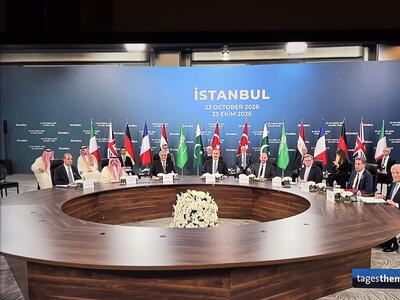
On October 23, a meeting was held in Istanbul attended by three European countries—Germany, France, and the United Kingdom—and four regional countries: Turkey, Saudi Arabia, Pakistan, and Egypt.
What was the purpose of this meeting? Can it be regarded as a form of mediation between Iran and the United States? What is the significance of the participation of three European countries alongside four regional states, some of which have previously concluded defence agreements?
Hakan Fidan, Turkey’s foreign minister, has emphasized that military intervention in Iran is not a solution and that another attack could expand the scope of the war across the region. Referring also to instability in the Black Sea and the Bab el-Mandeb Strait, he has warned of the consequences for energy supplies, food security, and global trade. Fidan has called for an end to the war and argued that, should hostilities continue, exceptional measures would be necessary to maintain the flow of energy and grain. His statements clearly reveal Turkey’s concern about the possible expansion of the conflict.
By contrast, Johann Wadephul, Germany’s foreign minister, while describing the meeting as positive and stressing the need to continue such efforts, adopted a critical position toward Iran and the Houthis. Accusing both of threatening international shipping and putting pressure on the global economy, he attributed responsibility for instability in the Middle East, the humanitarian crisis in Yemen, and food insecurity in countries of the Global South to them.
Although there is insufficient space here to examine the validity of these allegations or assess how closely they correspond to reality, one point is clear: the consequences of a war involving Iran would affect not only regional countries but also the global economy, particularly Europe.
Since the beginning of the war, Europe has played no effective role in containing or stopping it. This failure can be explained by at least two factors. First, Europe has been unable to adopt a firm and coherent position against violations of international law and human rights by the United States and Israel, perpetuating double standards. Second, Europe has been excluded from the principal decisions made by the United States and Israel regarding attacks on Iran.
Europe is now seeking to reassert ist diplomatic role, drawing on ist experience in nuclear negotiations with Iran. However, at the height of the confrontation between the United States and Israel on one side and Iran on the other, the decision by the three European countries—Germany, France, and the United Kingdom—to pursue the activation of the snapback mechanism at the United Nations Security Council, even though the United States had declared the JCPOA terminated several years earlier, has undermined Iranian confidence in these three countries. It has consequently diminished their ability to play an effective role in resolving the regional crisis, at least from the Iranian perspective.
By contrast, the efforts of the countries participating in the Mecca Agreement, together with Egypt, to prevent a new war appear more understandable from the standpoint of regional interests. This difference should inform Iran’s approach toward these countries.
Conclusion: Diplomacy in the Service of Iran’s Sustainability
The news of the unexpected flight of Saudi Arabia’s defence minister from Riyadh to Tehran was another significant development in recent days. According to published reports, he arrived alongside the head of Turkey’s intelligence agency and the commander of Pakistan’s army. Representing countries associated with the Mecca Agreement, they met with Mohsen Rezaei, secretary of the Islamic Republic’s Supreme National Security Council. Masoud Pezeshkian also met with senior officials from the three countries associated with the Mecca Pact: Prince Khalid bin Salman, Ibrahim Kalin, and General Asim Munir.
Undoubtedly, potential topics discussed at these meetings included the conditions set by Iran and the United States for reaching an agreement, the reopening of the Strait of Hormuz, the lifting of Iran’s naval blockade, the removal of sanctions, and, perhaps most importantly, the question of Yemen and the role of the Houthis.
Regardless of the outcome of these meetings, all forms of diplomacy and dialogue with the parties involved in the conflict should be welcomed. Nevertheless, diplomacy can achieve lasting results only when it is defined within the framework of a clear national security strategy. From this perspective, the principal elements of such a strategy can be summarised in several areas.
First, redefining the US military presence in the region.
Iran could identify the withdrawal of US military forces from the countries along the Persian Gulf as one of ist strategic objectives. In light of regional developments, including the Mecca Agreement, the Istanbul meeting, and the multilateral meetings in Tehran, it is now worth exploring whether this objective can be pursued through dialogue and regional security agreements.
At the same time, realism is essential: Iran has the capacity to disrupt the global economy, but it is not a superpower. Even the claim that Iran has unlimited authority to close the Strait of Hormuz was never a well-considered strategy, and it should not become an immutable principle of Iranian foreign policy. Such an approach would be unacceptable not only to many countries around the world but also to Iran’s friends and partners.
Although keeping the Strait of Hormuz closed could impose substantial costs on the United States and other countries, it would also damage Iran’s own economy and interests. Turning this situation into a protracted confrontation would amount to a zero-sum game that could ultimately inflict losses on all parties. Therefore, rather than expending political and military resources on maintaining the leverage of closing the strait, Iran should focus on achieving lasting security arrangements and reducing the factors that underpin the US military presence in the region.
Second, direct negotiations with the United States at the highest level.
To escape the current situation, Iran should declare ist readiness to engage in comprehensive, direct negotiations with the United States. In such negotiations, Iran could reaffirm ist commitment to refraining from acquiring nuclear weapons and, in return, seek the complete lifting of sanctions and an agreement on regional security arrangements.
Reducing and ultimately dismantling the US military presence in the region could also be included among the subjects of these negotiations. Such an agreement, however, would be sustainable only if the security concerns and interests of the region’s principal actors were taken into account.
Third, establishing a mechanism to reduce tensions with Israel.
Without addressing the conflict between Iran and Israel, any agreement between Tehran and Washington would remain vulnerable to instability and collapse. The key to changing course lies in a shift in Iran’s approach to the Israeli-Palestinian conflict and an emphasis on the two-state solution within the framework of United Nations resolutions.
Achieving this approach requires a paradigm shift in Iran’s foreign policy. Abandoning the slogan of Israel’s destruction and replacing it with a policy based on national interests, mutual deterrence, and de-escalation could constitute a necessary step in this direction.
Even if these measures were implemented, however, Iran might well remain in a state of “neither war nor peace” for a prolonged period. The fundamental issue, therefore, is not simply how to prevent war or guarantee the regime’s survival. It is how to choose a strategy capable of safeguarding the country’s future.
Iran’s national security strategy must be grounded in the sustainability of Iran—a concept encompassing national security, independence and territorial integrity, economic development, environmental protection, and the rights of all citizens.
The survival of a government, if achieved at the cost of social erosion, national decline, and the disregard of citizens‘ rights, cannot serve as a substitute for such a strategy.
Diplomacy in the shadow of war is valuable when it goes beyond the mere pursuit of survival and becomes an instrument for lasting peace, shared security, and the construction of a better future for Iran.
 چاپ
Add new comment